

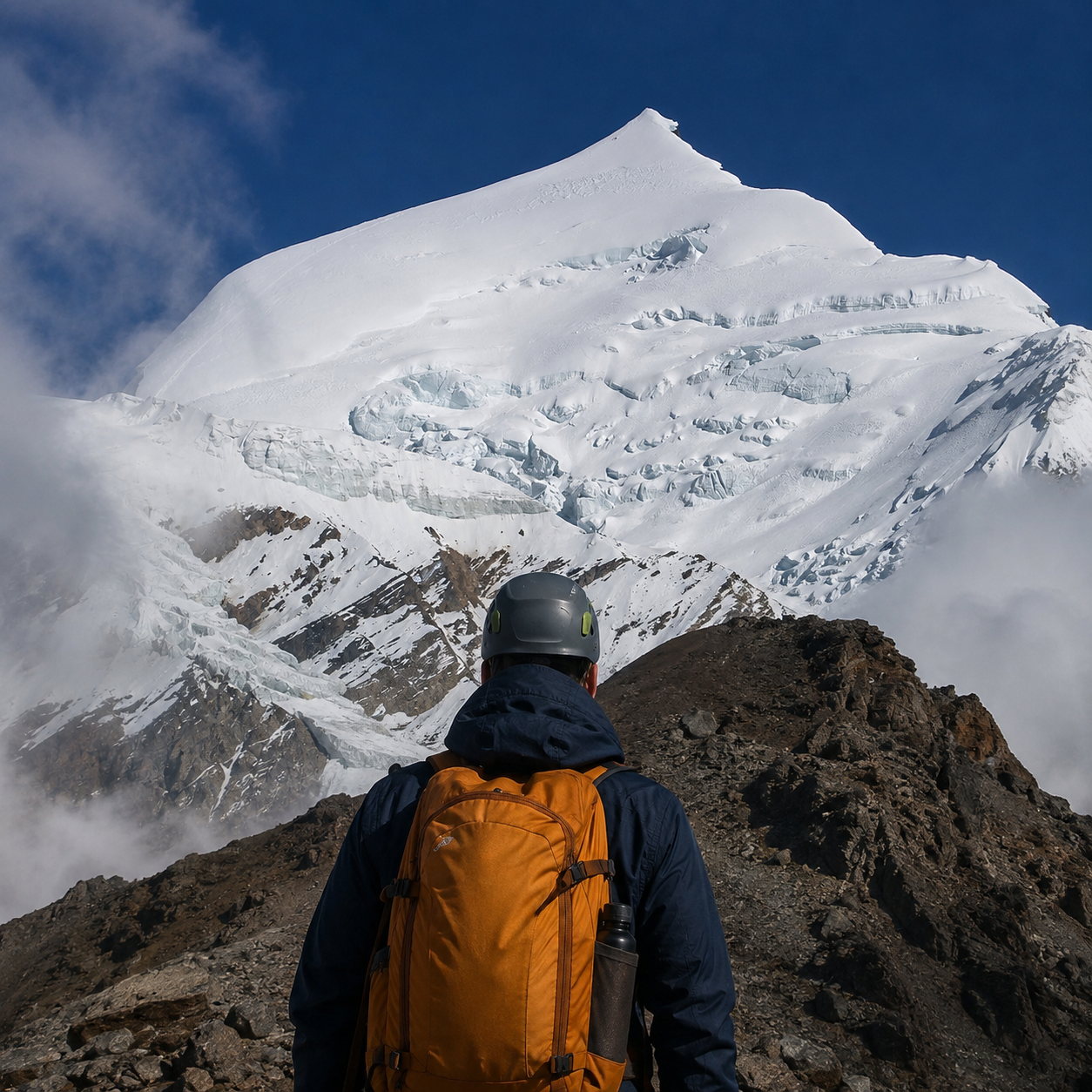
In a few weeks, I’ll leave the UK for Nepal to begin the Mount Himlung expedition.
At 7,126 metres, Himlung is considerably higher than anything I’ve attempted before.
It would therefore be very easy to make the summit the entire story.
But it isn’t. For me, Himlung isn’t the destination.
It’s the licence.
Why Mount Himlung?
Project Can’t was never designed around one mountain.
We have a much bigger ambition.
- Himlung in 2026.
- Manaslu in 2027.
- And ultimately, Everest from the north side in 2028.
You don’t simply jump from the mountains I’ve previously experienced to an 8,000-metre peak and hope everything works.
Himlung is the next step.
It gives us an opportunity to understand how I perform above 7,000 metres, how my equipment behaves, how my body responds and how we operate together as an expedition team.
There are questions we simply cannot answer from a training session in the UK.
We have to go and find out.
This isn’t just about me
One thing I want to make clear about the Mount Himlung expedition is that Project Can’t isn’t Jamie McAnsh climbing another mountain.
This time there is a team.
I’ll be attempting Himlung alongside Emma Forrest and Deri ap John Llewellyn-Davies.
Behind us is an even wider team of people helping with training, logistics, finance, filming, equipment, partnerships and the countless other things required to put an expedition like this together.
And when we reach Nepal, we’ll be working with Nima Sherpa and the team at SKA, whose knowledge and experience on the mountain will become an incredibly important part of the expedition.
Nobody does something like this alone.
The equipment has changed too
Himlung will also be the biggest test yet for the technology helping me walk.
For this expedition I’ll be using the Agilik powered orthoses developed and supplied through Thuasne and Bionic Power.
These aren’t simply another piece of climbing equipment.
They are helping provide movement and support that my body cannot reliably produce for itself.
Then there is everything else.
The walking poles supplied by WALX.
The technical climbing equipment supplied by DMM.
The equipment, clothing, batteries, communications and adaptations that we’ve spent months thinking about.
Every piece has a job.
At 7,000 metres, we get to discover whether all that preparation works in the environment it was intended for.
Success cannot just mean standing on the summit
This is perhaps the biggest lesson I’ve learned from previous challenges.
If the only acceptable outcome is a summit photograph, you can very quickly make poor decisions.
Mountains don’t care about your ambitions, your sponsors, your social media or how long you’ve spent preparing.
Conditions change.
Bodies change.
Plans change.
So yes, I want to stand on the summit of Himlung.
Of course I do.
But Project Can’t has a phrase that has become increasingly important to me:
We are not chasing a summit. We are building proof.
Proof that the equipment can operate in that environment.
Proof that we can operate effectively as a team.
Proof of what works.
And, perhaps even more importantly, evidence of what doesn’t.
Himlung is the beginning of the next chapter
When I think about Everest in 2028, it can feel enormous.
So I try not to.
There is another principle I’ve learned to live by:
Finish the one you’re on.
Right now, that one is Himlung.
Thirty days.
7,126 metres.
A new team.
New technology.
A completely new set of questions.
We’ll go to Nepal, do everything we can to answer them and come home knowing considerably more than when we left.
Then we’ll decide what comes next.
Because sometimes the biggest ambitions aren’t achieved by staring at the destination.
They’re achieved by understanding the importance of the next step.
And for Project Can’t, that next step is Mount Himlung.