

What does resilience mean when life doesn’t go according to plan? For me, it has never meant being unbreakable. It means learning what to do when things become difficult, when circumstances change, and when getting back up looks very different from how you imagined it would.
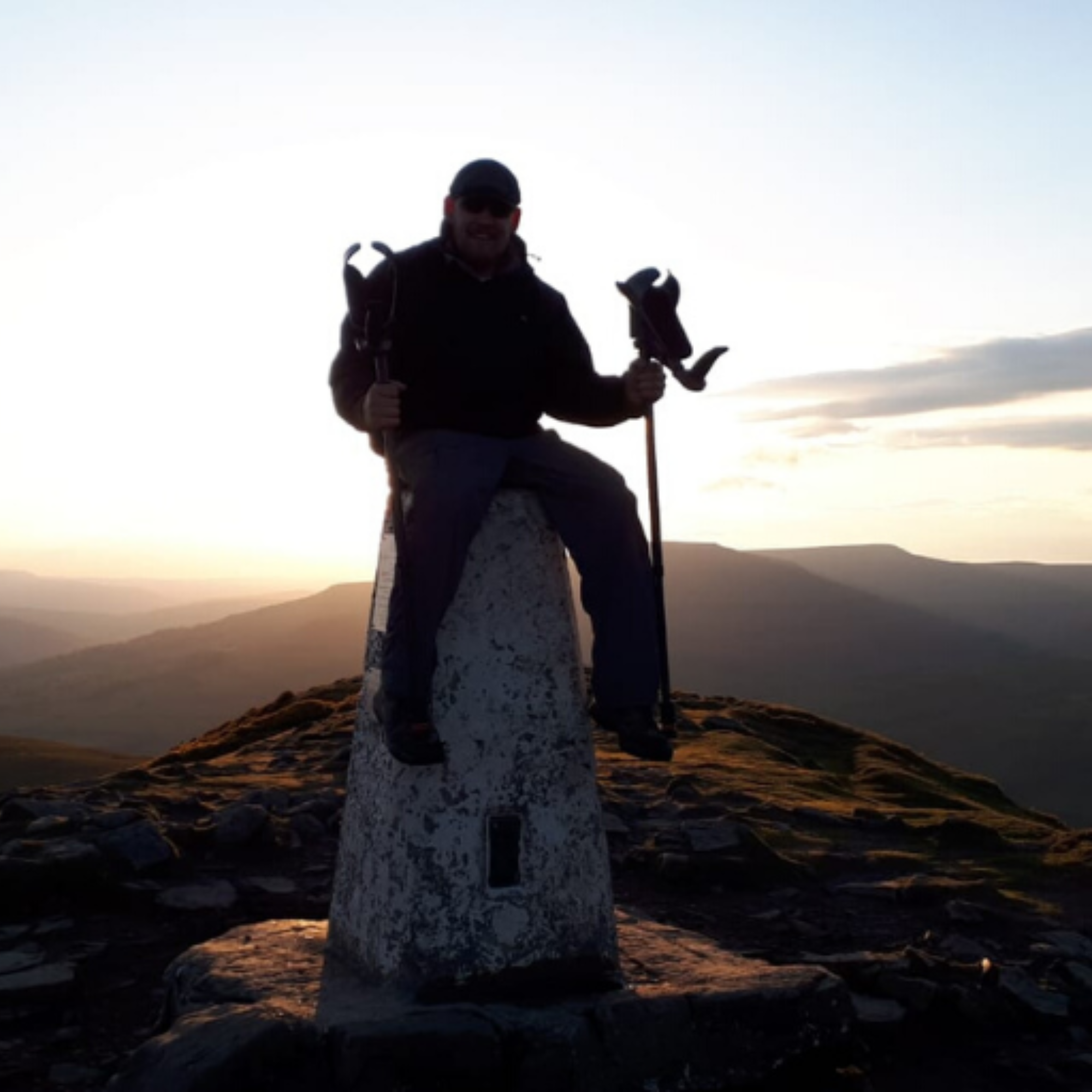
There is a photograph of me sitting on a trig point at the top of a mountain, my crutches in my hands and the sun dropping behind the hills. If you looked at that photograph without knowing the story, you could easily see it as an image of resilience. Someone faced a challenge, climbed a mountain and reached the top. Job done. It is exactly the sort of image we associate with overcoming adversity, but photographs like that only capture a moment. They don’t show everything that came before it, and they certainly don’t tell you what was happening inside the person sitting there.
That is one of the problems I have with the way we sometimes talk about resilience. We see the outcome and create a story around it. We describe people as strong, determined, courageous or even inspirational because they have overcome something difficult. What we don’t always see are the moments of doubt, frustration, fear, anger or exhaustion that existed alongside the achievement. We see somebody standing at the top of the mountain, but we don’t see all the moments when they wondered whether they were going to get there.
What Does Resilience Mean?
If you search for what does resilience mean, you will find plenty of definitions about our ability to recover from difficulty and adapt to challenging circumstances. Those definitions aren’t wrong, but my understanding of resilience has been shaped far more by experiencing it than reading about it.
For me, resilience isn’t about becoming so mentally tough that nothing affects you. It isn’t about developing some kind of emotional armour that allows difficulty to bounce off you. And it definitely isn’t about pretending everything is fine when it isn’t.
Resilience is much more human than that.
It is being affected by something and still finding a way forward. It is acknowledging that something hurts without allowing that pain to make every decision about what happens next. It is recognising that you are struggling and sometimes admitting that you need support. It is accepting that the person who gets back up might not be exactly the same person who fell.
That last part has become particularly important to me.
Being Strong Doesn’t Mean Never Struggling
Over the years, people have occasionally described me as incredibly resilient. I understand where that comes from. They look at parts of my story, the challenges I have faced, the mountains, the crutches, the adventures and everything that has followed, and resilience seems like a reasonable word to use.
But there is a danger in assuming that somebody who is resilient doesn’t struggle.
I have struggled.
There have been days when motivation has disappeared. There have been moments when I’ve questioned myself, become frustrated with my circumstances and wondered how I was going to deal with the next challenge. There have been times when I’ve needed other people around me and times when the strongest decision I could make was to stop rather than continue pushing.
None of that cancels out resilience.
In fact, I think understanding this is essential if we want resilience to be something useful rather than just another word we attach to people after they have survived something difficult.
You don’t fail at resilience because you had a bad day. You aren’t suddenly less resilient because something overwhelmed you. You don’t have to smile your way through adversity to prove that you are coping.
Sometimes resilience looks impressive from the outside. Sometimes nobody else even knows it is happening.
Resilience Can Be Quiet
We naturally notice the big moments. Reaching the summit. Finishing the challenge. Returning to work. Standing on a stage. Crossing a finish line. Those moments are easy to photograph and easy to celebrate.
But some of the most important acts of resilience happen without an audience.
Sometimes resilience is getting out of bed when you would rather stay there. Sometimes it is making a phone call you’ve been avoiding. It can be asking for help, having a difficult conversation or accepting that something needs to change. It can be starting again after an idea hasn’t worked or allowing yourself enough time to recover before trying again.
None of those moments are likely to end up in a highlight reel, but they matter.
That is something the mountains continue to reinforce for me. Reaching a summit is fantastic, but the summit isn’t the whole story. Every decision made before reaching it matters too. The preparation, adaptations, setbacks, conversations and moments when you choose to continue all form part of the achievement.
When you understand resilience that way, it becomes much more accessible. You don’t need to climb a mountain to practise it.
You Don’t Have to Be Unbreakable
I don’t particularly like the idea of being unbreakable.
Something that cannot bend eventually reaches a point where the pressure becomes too much. Human beings aren’t designed to go through life untouched by what happens to us. Experiences change us. Difficulties leave marks. Success changes us too.
The goal shouldn’t be to become unaffected.
The goal is to become adaptable.
There is strength in being able to change your approach when circumstances demand it. There is strength in recognising that the old solution no longer works. There is strength in allowing other people to support you and in understanding that independence doesn’t have to mean doing everything alone.
Perhaps most importantly, there is strength in giving yourself permission to rebuild differently.
I’ve learned that getting back up doesn’t always mean returning to where you were before. Sometimes the circumstances have changed too much for that. Sometimes you have changed too much for that.
The question then isn’t, “How do I get my old life back?”
It becomes, “What can I build from here?”
There is a huge difference between those two questions.
Resilience Is Something We Practise
I don’t believe resilience is something a fortunate few are simply born with. I think it develops through experience, reflection and the decisions we make when things don’t go according to plan.
Every time you adapt rather than quit, you practise it. Every time you ask for support instead of pretending you don’t need it, you practise it. Every time you recognise what you can control and stop wasting energy fighting what you cannot, you practise it.
That doesn’t mean the next challenge becomes easy. Experience doesn’t give us immunity from difficulty. What it can give us is evidence.
Evidence that we have faced uncertainty before.
Evidence that we have adapted before.
Evidence that we have found another route before.
When the next difficult moment arrives, that evidence matters. You might not know exactly how you are going to get through it, but you know that not knowing the answer immediately doesn’t mean there isn’t one.
The Photograph Doesn’t Tell the Whole Story
When I look at that photograph of me on the mountain, I am proud of it. I’m proud of reaching that point and of everything represented by the crutches in my hands and the landscape stretching out behind me.
But I don’t look at it and see somebody unbreakable.
I see somebody who kept learning.
I see adaptations, difficult days, decisions, support from other people and plenty of occasions when the route forward wasn’t obvious. I see somebody who didn’t always know what came next but kept trying to find out.
And perhaps that is a better answer to the question, what does resilience mean?
It doesn’t mean that nothing can knock you down.
It doesn’t mean you never struggle, doubt yourself or need help.
It doesn’t mean you have to become tougher than everything life can throw at you.
For me, resilience is knowing that when something changes, when a plan fails or when life knocks you somewhere you never expected to be, the story doesn’t necessarily finish there.
You assess where you are. You work with what you have. You accept support when you need it. You adapt.
And then, when you are ready, you find your way forward.
You don’t have to be unbreakable to be resilient. You just have to keep discovering what getting back up means for you.