

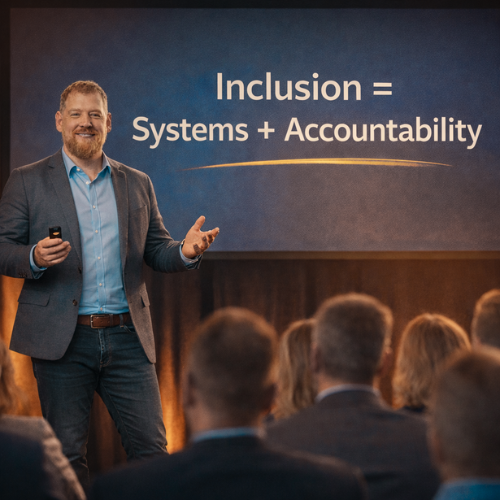
And why inclusive intentions falter without inclusive systems is a conversation that many organisations still don’t want to have. Good people with good values often tell themselves that intent is sufficient. It isn’t. I’ve worked with businesses that actually care about diversity and inclusion. Leaders who care deeply about fairness. Teams that go into training and are open. But months later, very, very little has changed. Not because people did not care. But because the systems just never supported change. Inclusion is not based on intent. It is built on infrastructure.
Why Inclusive Intentions Fail Without Inclusive Systems in the Workplace
Most organisations don’t fully understand why inclusive intentions fail. They start their inclusion journey with awareness training. Workshops. Webinars. Speaker sessions. These are important. I’ve delivered many myself. But awareness without operational change becomes theatre.
A company might claim to appreciate varied talent. But if its recruitment system is based on discriminatory referral networks, inflexible job descriptions or inaccessible job application platforms, the results will be contrary to the intent.
A leader might claim to support disabled employees. But if reasonable adjustments require excessive bureaucracy, unclear approval processes, or line managers’ discretion without direction, then the problem is that the system is the barrier.
Culture follows structure. Always. This is a golden rule.
Neurodivergent employees will face serious problems if performance reviews reward presenteeism rather than output. In other words, if the criteria for promotion are based on visibility over impact, it would miss out on introverts and remote workers. If communication platforms are not accessible, some voices will never be heard.
Inclusion fails not because people are resistant, but because systems are misaligned.
The Gap Between Values and Operations
Values are present on every single organisation’s website. Words such as integrity, respect, belonging, and collaboration.
And the hard question is, do your processes hold up to those values?
- Look at hiring.
- Look at onboarding.
- Look at data collection.
- Look at performance metrics.
- Look at leadership pipelines.
If your systems were audited blindly, without someone to explain them, would they reflect inclusion?
When I woke up paralysed in 2014, I entered systems that were not designed for sudden disability. Healthcare processes assumed mobility. Public spaces assumed independence. Workplaces presumed physical consistency. I even got singled out not for what I could not do, but for what I could do differently that the organisation had decided was a health and safety issue. For example, the policy stated that no bags were to be hung on the back of chairs. This was taken literally, and yes, I got pulled up for hanging my bag on the back of my wheelchair. The only way possible for me to carry my bag.
The problem was not malicious intent. It was a structural design. That was the policy; we have to live by the policy. However, there needs to be an understanding of the individual rather than a one-size-fits-all approach.
That lesson can be applied to almost any business.
Inclusion isn’t just about reacting well when someone discloses a need. It is about designing so that fewer barriers exist in the first place.
Moving Beyond Training Towards Structural Inclusion
Training changes awareness. Systems change outcomes.
If organisations intend for inclusion to work, they need to embed it into their operational design:
Recruitment systems must anonymise bias where possible and intentionally widen talent pools.
Performance systems need to measure impact fairly and transparently.
Technology platforms must be accessible by default, not after complaint.
Leadership accountability should include measurable inclusion metrics, not vague commitments.
This is the space where inclusive technologies are invaluable. AI and digital systems, responsibly used, can reduce bias, flag disparities, and automate accessibility adjustments. But technology needs to be guided by an inclusive strategy. Tools amplify what already exists, good and bad.
Inclusion can’t be left to HR alone. It needs to be embedded in operations, data, leadership KPIs, and digital infrastructure.
That’s how values become lived reality.
Inclusion as a System, Not a Sentiment
The organisations which actually succeed are those that stop asking, “Do we care?” and start asking, “How does our system behave?”
Because systems are the truth-telling machine.
- They show who progresses.
- Who leaves.
- Who speaks up.
- Who stays silent.
- Who feels safe.
If inclusion relies on exceptional managers being kind, then it is fragile. If it relies on fair processes, it is sustainable.
This is the shift from culture conversation to culture construction.
Intent matters. It sets direction.
But the destination is determined by systems.
And if that’s the scenario that we want workplaces to function in where everyone can flourish, then we must make sure our structures bear the weight of our values.
Not just our words.